Key Takeaways
- There are three primary tagless label printing methods: heat transfers, screen printing, and pad printing.
- Pad printing is the preferred tagless method for most apparel brands, offering low start-up and operating costs, instant dry time, and a soft-to-touch finish.
- Heat transfers and screen printing both carry a higher risk of the label cracking or peeling off over time compared to pad printing.
- Ink choice is as important as much as the printing method; Inkcups offers three tagless ink lines formulated for adhesion and wash durability.
There are three primary methods for tagless t-shirt label printing: heat transfers, pad printing, and screen printing. Choosing between them comes down to durability, comfort, cost, and turnaround time.
For those not familiar with the term “tagless,” let’s begin there. Tagless label printing is the process of directly printing the logo onto the fabric, bypassing the use of a traditional fabric tag sewn into a garment. By today’s standards, fabric tags are a nuisance to all ages — we’ve grown accustomed to everything from underwear, to athleisure, to uniforms being comfortable and tagless. Printing directly onto the garment can save time, money, and consumables.
-

-
Tagless Jeans – Pocket Print
-

-
Tagless Scrubs
-

-
Tagless Button-Up Shirts
What are Shirt Label Printing Methods?
There are three methods primarily used for tagless printing. Let’s explore each:
- Heat Transfers: This process begins with digitally printing the label design onto a sheet of heat transfer paper. The operator then uses several additives and heat to transfer the label onto the fabric. This process is more extensive than it appears and requires a few pieces of equipment to complete start to finish, including a computer, printer, ink, heat transfer paper, a cutter, heat press, heat pad, heat tape, and heat-resistant sheeting.
- Screen Printing: This process uses a mesh screen, a squeegee, and specialized ink to print the label onto the fabric directly. Screen printing is a time-consuming option as not only does the shirt need to be turned completely inside out to print on, but the dry time is of the ink can be lengthy as well.
- Pad Printing: This process begins with an ink cup running along an etched plate where a pad picks up the inked design to press it to the fabric. Pad printing machines are made up of three main parts: a silicone print pad, an ink cup, and an etched plate. Compared to heat transfers and screen printing, pad printing only lays down a thin layer of ink, which is partially absorbed by the fabric, resulting in a soft to touch finish.
Preferred Tagless Method: Pad printing is often the top choice for tagless printing as it offers low start-up costs, low operating costs, instant dry time, high durability, and comfort. Both heat transfers and screen printing can lead to labels cracking or peeling off.
Machines for Shirt Label Printing: Questions to Ask
Inkcups offers multiple pad printers to streamline your business. When it comes down to deciding which pad printer is the best fit for your operation consider the following factors:
- How many colors do you wish you print with?
- Do you need a single or dual color pad printer?
- How big is the image you wish to print?
- What color fabric do you wish to print on?
Inkcups Pad Printers for Tagless
The B100 Tabletop Pad Printer is the perfect machine for those looking to print one-color tagless tags that have an artwork size of up to 3”. Operating at full speed, the B100’s output is between 900 to 1300 impressions per hour.
The B150 Large Image Label Printer is a pad-printer for one-color graphics that are up to 5.5” in diameter. With a compression capability of 779 lbs, this pad printing machine allows for easy handling of large, hard printing pads and produces high-quality images on drinkware.
Inkcups’s ICN2200-PS 2-Color Pad Printer accommodates two-color graphics and images that are up to 3” in diameter. The pad slide on the ICN2200 simplifies part fixturing and assures flawless second-color registration on promotional products, industrial products, and apparel items.
As you can see here, the main differentiators between the pad printers that Inkcups offers are the image size, and whether the pad printer can print one or two colors.
Ink for Tagless Printing
-

-
SB Ink for Apparel Tags
-

-
SB Eco Series for Apparel Tags
-

-
SB Brite Opaque Garment Printer Ink
Ink is specially formulated for fabric apparel to achieve superior adhesion, just like with drinkware. Within the textile industry, the goal for ink adhesion is to last a set amount of runs through an industrial washing machine. Inkcups currently offers three different tagless printing inks – let’s explore the three lines in greater detail.
- The ink most commonly used for apparel tags is the SB Ink for Apparel Tags. It is high-quality, high-flexibility, quick-drying, and will not crack on even the trickiest of fabrics. While great quality and flexibility are nice features to have , it is paramount that pad printed items dry quickly, as operators quickly stack apparel pieces after they meet the pad, and they will smudge or bleed if they are not dry.
- The most sustainable garment ink available today is the SB Eco Series for Apparel Tags. This line of ink holds all the qualities of the original SB ink while being eco-friendly, lacking harsh chemicals. This line has 24 different colors and adheres to 98% of fabrics including cotton, polyester, rayon, and many more.
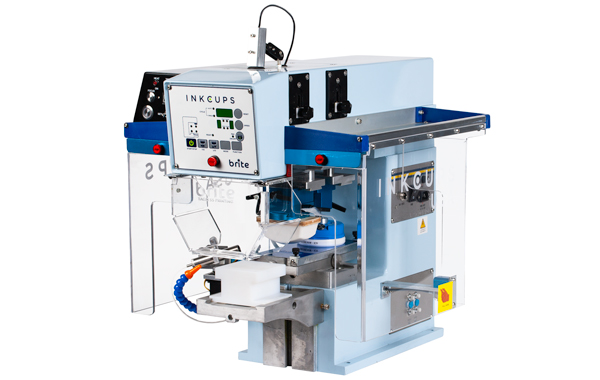
- The third line of ink is the SB Brite Opaque Garment Printer Ink. It consists of Brite white and is intended to really pop when it comes to light-on-dark prints. This line of ink was created especially for the Brite Label Printing Machine. As the name implies, it is super opaque for crisp prints.
All three of the pad printing inks carried by Inkcups produce soft-hand prints, meaning that running your hand over the printed label is almost unnoticeable.
If you’ve decided that tagless printing is the next great move for your business, speak with an Inkcups sales representative in your area to discuss how we can help with your specific wants and needs.
Frequently Asked Questions
Q: What is tagless t-shirt label printing?
A: Tagless printing applies a logo or care label directly onto fabric instead of using a sewn-in tag, saving time, money, and consumables while improving comfort for the wearer.
Q: Which tagless printing method lasts longest?
A: Pad printing generally offers the best durability and comfort of the three tagless methods, since it lays down a thin, soft-hand layer of ink that resists cracking and peeling better than heat transfers or screen printing.
Q: Can tagless labels be printed on dark fabric?
A: Yes. A great trick is to use Cool Grey 6 on dark fabrics.
 Tagless Printers
 Cylindrical Inkjet Printers
 UV Flatbed Printers
 Pad Printing Machines
 Pretreatment Systems
 Inkjet Printing Auxiliary
 Laser Plate-Makers
 Inkjet Printing Supplies
 Pad Printing Supplies
 Tagless Supplies
Add Your Comment