If you’ve ever built a LEGO® set, you’ve probably noticed that some parts are decorated with colorful graphics while others rely on molded plastic colors or decals. From minifigure torsos and faces to instrument panels and specialty pieces, these printed graphics help bring each model to life.
Collectors, hobbyists, and manufacturers alike often ask the same question:
How are LEGO bricks printed?
Search YouTube, Reddit, or any printing forum and you’ll find countless DIY methods, but one answer consistently rises to the top. Official LEGO parts are primarily decorated using pad printing.
Why Pad Printing is Used for LEGO Parts
Take a closer look at a LEGO minifigure. Most torso designs consist of one to four spot colors, making them an ideal application for pad printing.
While UV digital printers can produce full-color graphics, pad printing remains the preferred production method for many molded plastic parts because it offers:
- Excellent registration of multiple spot colors
- Fast production speeds
- Consistent image quality
- Outstanding repeatability
- The ability to print onto small, irregularly shaped surfaces
Since silicone pads conform to the shape of the part, pad printing can decorate features that would be difficult for many other printing processes.
How Does Pad Printing Work?
Although pad printing is an industrial process, the fundamentals are surprisingly straightforward.
Every pad printer relies on three primary components:
- A laser-etched or photopolymer printing plate containing the artwork
- A sealed ink cup that applies and delivers just enough ink across the plate
- A silicone printing pad that transfers the image to the part
Here’s how the process works:
- The ink cup fills the etched image with ink while removing excess ink from the plate surface.
- The silicone pad presses onto the plate and lifts the inked image.
- The pad then transfers the image onto the LEGO brick or component, which is securely held in a custom fixture.
Because the silicone pad compresses around contours, it can accurately decorate raised, recessed, and curved features with exceptional precision.
What Material Are LEGO Bricks Made From?
The classic LEGO brick is manufactured from ABS (Acrylonitrile Butadiene Styrene), an engineering-grade thermoplastic known for its:
- High impact resistance
- Excellent dimensional stability
- Strong tensile strength
- Long-term durability
Beyond standard bricks, LEGO also manufactures specialty components from several additional materials, including HIPS, PA (nylon), MABS, TPO, PC, Bio-PE, POM, PP, TPU, and SEBS. These materials are commonly used for accessories, hinges, weapons, flowers, flexible components, and other specialty pieces.
Each plastic has different surface characteristics, so selecting the appropriate ink system is essential for achieving reliable adhesion.
Choosing the correct ink is just as important as selecting the right machine.
For ABS plastics, Inkcups commonly recommends one of the following pad printing ink series:
The best choice depends on factors such as the substrate, production environment, required durability, and any post-processing requirements.
At Inkcups, our application specialists perform professional adhesion testing to identify the ink system that delivers the best long-term performance for your specific plastic and production process.
Choosing a Pad Printer for LEGO Applications
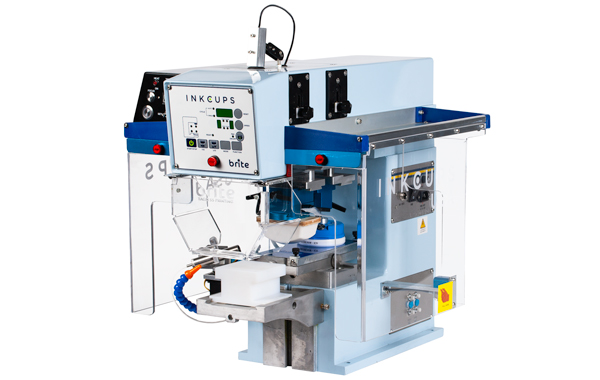
Inkcups offers pad printers ranging from one-color tabletop systems to fully automated six-color production machines.
Since LEGO bricks and components are relatively small, virtually every Inkcups pad printer can accommodate their size. The ideal machine primarily depends on the number of colors required and your desired production volume.
For example:
- One-color pad printers are ideal for logos, text, faces, and simple graphics.
- Two- and four-color systems are well suited for most minifigure torsos and decorative parts.
- Six-color pad printers provide greater flexibility for complex artwork requiring multiple spot colors.
With custom fixturing, precision laser plate making, and the proper ink system, manufacturers can consistently produce crisp, repeatable decoration on even the smallest plastic components.
Complete Pad Printing Solutions from Inkcups
Whether you’re decorating promotional building bricks, educational products, toy components, or custom molded plastic parts, Inkcups provides everything needed to build a complete pad printing solution.
Our product lineup includes:
- One- to six-color pad printing machines
- High-performance inks for ABS and many other plastics
- Silicone pads in a wide variety of shapes and durometers
- Laser plate-making equipment and consumables
- Custom fixturing and application consulting
- Adhesion testing and technical support
From selecting the right ink to optimizing your printing process, our experts help manufacturers achieve consistent, high-quality decoration on plastic components of nearly any shape. Contact us today.
 Tagless Printers
 Cylindrical Inkjet Printers
 UV Flatbed Printers
 Pad Printing Machines
 Pretreatment Systems
 Inkjet Printing Auxiliary
 Laser Plate-Makers
 Inkjet Printing Supplies
 Pad Printing Supplies
 Tagless Supplies
Add Your Comment