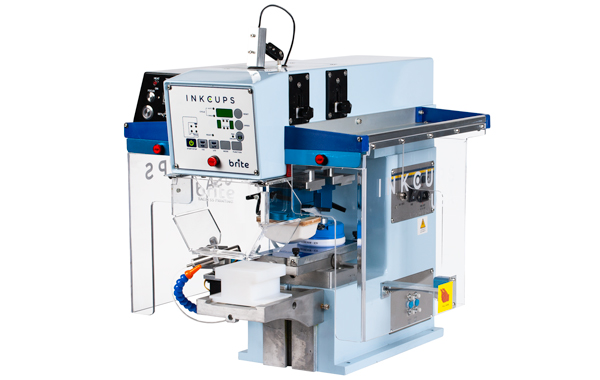
 Tagless Printers
 Cylindrical Inkjet Printers
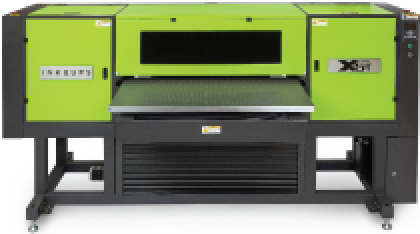 UV Flatbed Printers
 Pad Printing Machines
 Pretreatment Systems
 Inkjet Printing Auxiliary
 Laser Plate-Makers
 Inkjet Printing Supplies
 Pad Printing Supplies
 Tagless Supplies
How direct-to-object printing is powering diversification into promotional print
By Ryan Quinn, Global Sales & Business Development, Inkcups
How direct-to-object printing is powering diversification into promotional print
By Ryan Quinn, Global Sales & Business Development, Inkcups
Promotional products have evolved. The days of bulk-buying inexpensive items, adding a logo and using them for every trade show and customer promotion are gone, and today brand owners and consumers expect a more tailored approach. Personalization in promotional goods is on the rise, mass customization is well into the mainstream, and buyers increasingly look for products that match both their campaign goals and their business’ sustainability objectives.
Thoughtfully curated branded merchandise delivers meaningful impact, so it’s unsurprising that the promotional products market has rebounded since 2020. Indeed, despite some challenging conditions, in 2024 European sales of promotional products grew by an estimated 1.22% according to ASI Research, with sales of promotional products in Spain experiencing one of the highest growth rates in Europe at 7.6% in 2024.
Recognizing the opportunity, many print service providers are exploring ways to diversify into promotional products, both as a complement to their existing services and in order to deepen customer relationships and transition from occasional supplier to indispensable partner.
Many commercial printers are already familiar with marketing tactics and have strong relationships with brand managers. Adding promotional items can be a logical next step, particularly when you consider the appeal of simplifying procurement and brand compliance for their customers. For some, expansion may come in the form of branded apparel, but increasingly many are looking to items such as stationery, technology peripherals, drinkware and even décor.
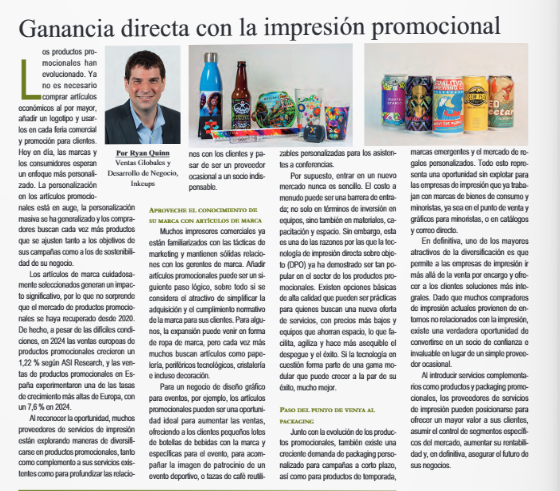
For an events graphics business, for example, promotional items can be an ideal opportunity to upsell by offering customers small batches of branded, event-specific drinks bottles to accompany sponsorship branding for a sporting event, or personalized reusable coffee cups for conference attendees.
Of course, moving into a new market is never simple. Cost can often be a barrier to entry; not just in the form of equipment investment, but also materials, training and floorspace. This, however, is one of the reasons that direct-to-object printing technology has already proven so popular in the promotional products arena. High quality entry-level options exist and can be practical for those with their eye on a new service offering, with lower price points and space-efficient equipment making it easier, faster, and more affordable to get off the ground and thrive. If the technology in question is part of a modular range that can grow in tandem with their success, so much the better.
Alongside the evolution of promotional products, there is also a growing demand for custom packaging to tie in with short-term campaigns, as well as for seasonal products, emerging brands and the personalized gifting market. All of this represents an untapped opportunity for print businesses already working with consumer goods brands and retailers, whether that is in point-of-sale and retail graphics or catalogs and direct mail.
Direct-to-object inkjet printing in particular is enabling more agile, responsive and creative approaches to production, and simultaneously breaking down barriers to entry for those seeking to diversify into packaging. With the right technology, inks and pretreatment, direct-to-object printing makes it possible to print 2D images directly onto almost any shape you can imagine, expanding packaging printing capabilities far beyond boxes and wraps to encompass cylindrical printing onto aluminum cans, glass, metal and plastic bottles, presentation boxes and more. Bespoke packaging can quickly become a profitable complementary service for print service providers, particularly those operating in regions with burgeoning local industries such as winemaking, craft brewing or independent cosmetics, as well as those with a customer base in the hospitality industry.
Ultimately, one of the biggest appeals of diversification is that it makes it possible for print businesses to move beyond job-by-job selling and offer customers more comprehensive solutions. With many print buyers today coming from non-print backgrounds, a real opportunity exists to become a trusted and invaluable partner instead of just an occasional supplier. By introducing complementary services such as promotional products and packaging, print service providers can position themselves to deliver greater value for customers, take ownership of particular market segments, increase their profitability, and ultimately future-proof their businesses.
To learn more about diversification opportunities with direct-to-object printing, visit the Inkcups booth (B39) at FESPA 2026 in Barcelona in May.
This article was written for and published originally in Spanish for La Presa Magazine and can be found here.
Add Your Comment