 Tagless Printers
 Cylindrical Inkjet Printers
 UV Flatbed Printers
 Pad Printing Machines
 Pretreatment Systems
 Inkjet Printing Auxiliary
 Laser Plate-Makers
 Inkjet Printing Supplies
 Pad Printing Supplies
 Tagless Supplies
The Challenges of Inkjet Printing on Curved Surfaces
By: Derek LaChance, Digital Product Manager
This article was originally published in 2019 and has been updated as of March 2026 to reflect major advancements in digital printing technology.
By: Derek LaChance, Digital Product Manager
This article was originally published in 2019 and has been updated as of March 2026 to reflect major advancements in digital printing technology.
Over the past several years, one of the biggest limitations of inkjet printing has been its ability to print on curved or irregular surfaces. Traditionally, companies relied on flatbed printers for flat objects and turned to analog methods like pad printing for curved printing or anything more complex.
Today, that landscape has changed significantly.
With the introduction of High Throw technology, digital inkjet printing can now reliably decorate surfaces with greater variation in height, including curves, recesses, and stepped surfaces. What was once considered a limitation of inkjet printing is now becoming one of its fastest-growing applications.
High Throw technology is an advancement in digital UV printing that allows ink droplets to travel a greater distance from the printhead to the substrate without sacrificing image quality.
Traditionally, inkjet printheads required extremely tight tolerances, often within 1–2 mm of the surface, to maintain sharpness and accuracy. This limits the ability to print on anything beyond flat or slightly curved objects.
High Throw changes that.
By increasing the distance ink can travel while maintaining precise drop placement, High Throw-enabled printers can now produce crisp, detailed images across:
This advancement expands the capabilities of digital printing into applications that were previously dominated by analog processes.
Flatbed inkjet printing works similarly to the inkjet printers found in homes and offices, but flatbed inkjet printers can accommodate a wider range of substrates and object sizes than a standard inkjet printer. Flatbed inkjet printers offer several key advantages:
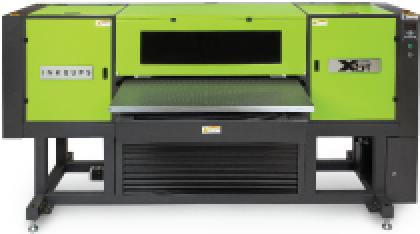
Since the parts travel into the machine on a travelling fixture and back out, manual loading and unloading of the fixture is necessary. This flatbed delivery system is typical for both large and small format pieces. To see a flatbed inkjet printer in action, watch this demo video of our X5-T High Throw Flatbed Inkjet Printer:
Flatbed inkjet printing is also more environmentally friendly and economical than traditional solvent-based printing. The type of ink and the curing process differentiates flatbed printing from standard inkjet printers. UV curable ink is made from acrylic monomers, which instantly cure, or polymerize, when exposed to UV light. Flatbed inkjet printing operations are used in a wide variety of industries, most prominently in the promotional, electronic, industrial, and drinkware sectors.
Additional Resources:
Flatbed inkjet printing offers significant advantages compared to traditional analog methods. It reduces manufacturing costs, simplifies workflows, and enables high-mix, low-volume production. Customization and personalization become practical and scalable, while full-color, high-resolution graphics can be produced directly from a digital file.
As industries continue to shift toward more flexible and on-demand production, inkjet technology has become a key driver of that transformation.
To understand how far inkjet technology has come, it’s important to look at its original limitations.
Inkjet printheads were designed to print on flat surfaces, where the distance between the printhead and the substrate remains consistent. Ink droplets are jetted only a few millimeters before they begin to lose accuracy. For the highest print quality, the printhead must remain very close to the surface.
Because of this, even small changes in height or curvature could impact:
For example, when printing on a spherical object like a ping pong ball, only the area closest to the printhead achieves optimal quality. As the surface curves away, the distance increases, resulting in reduced print clarity.
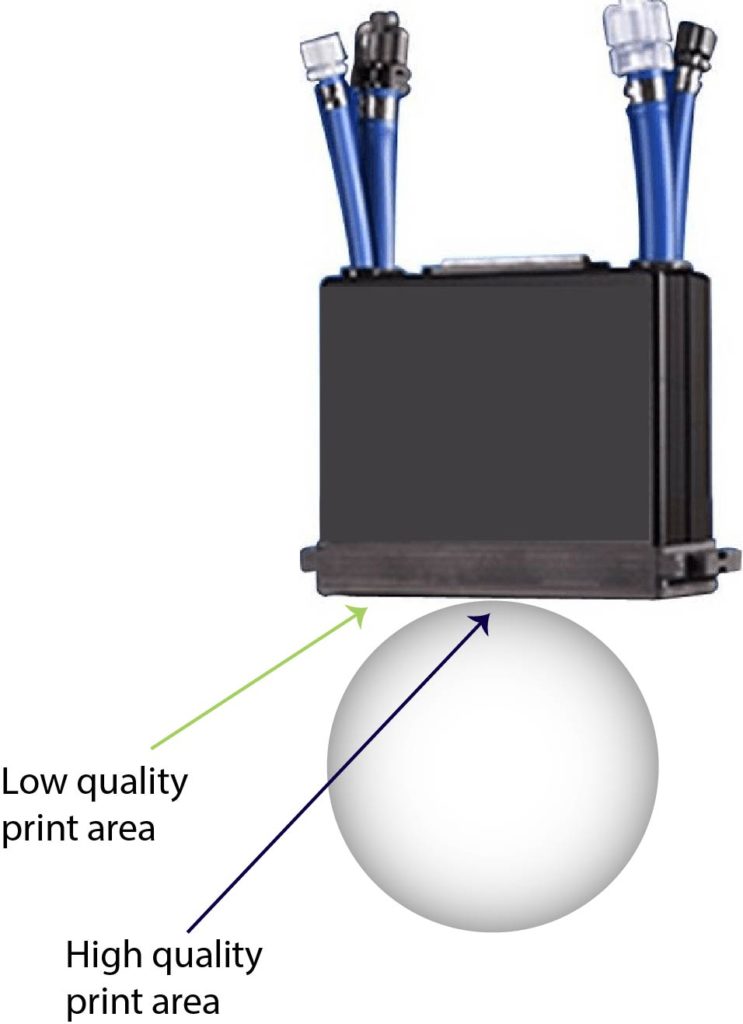
Geometry Matters When Printing
Adding a third dimension introduces additional complexity.
Objects can generally be categorized into:
Discontinuous geometries are particularly challenging because the distance between the printhead and the surface varies across the print area, requiring compensation to maintain image quality.
Historically, these limitations meant that many curved or irregular objects required alternative printing methods.
Today, advancements like High Throw technology are redefining these constraints by allowing ink to travel further while maintaining precise placement, significantly expanding what is possible with digital inkjet printing.
The X5-T High Throw can flawlessly print on up to 25% of curved and uneven surfaces.
Previously (Pre-High Throw):
Inkjet printers were originally designed for flat surfaces. Printheads could only jet ink a few millimeters before accuracy and image quality degraded. This meant that:
Because of this, many companies relied on pad printing or screen printing for curved or irregular items.
Today (With High Throw Technology):
High Throw significantly reduces these constraints.
Modern UV inkjet systems can now maintain image quality across greater distances, allowing for:
While extreme geometries can still present challenges, the practical limitations of inkjet printing have been dramatically reduced.
Before advancements like High Throw, analog processes such as pad printing and screen printing were essential for decorating curved and irregular surfaces. These methods played a critical role in applications where traditional inkjet printing could not reliably perform.
Pad printing remains a highly effective solution for simple graphics, limited color applications, and highly irregular shapes. Similarly, screen printing continues to be ideal for high-volume production and low-mix, repeatable jobs where consistency and efficiency are key.
However, both methods come with trade-offs. They typically require setup time, consumables, and manual processes, and they offer limited flexibility when it comes to customization or quick design changes.
With modern digital inkjet advancements, many of these same applications can now be produced using full-color output, faster changeovers, and variable data printing. These capabilities allow for greater personalization while reducing setup requirements and material waste.
Rather than replacing traditional methods entirely, High Throw technology expands the range of applications where digital printing can be used effectively, giving manufacturers more flexibility in how they approach production.
Inkcups understands the limitations of traditional printing methods and is constantly innovating new solutions. We are focused on market expansion and production-capable systems.
We have customized our larger printers, such as our X5-T, to utilize the latest printhead technology in order to print onto flat or slightly curved products up to 20 inches tall. Our Helix® rotary inkjet printer is designed to print superior quality full-color images on straight-walled and tapered cylinders. This machine is ideal for use in drinkware, barware, candle, and industrial printing industries. In addition to the numerous UV printers and inkjet inks we carry, we also perform all adhesion requirements for you. Once we have completed adhesion testing according to ASTM guidelines, we will send your samples back to you along with a comprehensive report.
Inkcups is your partner who understands your individual business needs. We are constantly innovating new solutions and are focused on your success. Our departments collaborate to create state of the art new machines that outperform other machines on the market on a price/performance basis. For more information, contact us today.