Some substrates just don’t play by the rules. Handled mugs. Stepped tumblers. Stress balls. Pickleball rackets. Hard hats. These are the items that traditional UV printers struggle with – and where Inkcups’ High Throw Technology changes the game.
What you may have heard as “high gap printing” – the ability to jet ink across a greater distance between the printhead and the substrate – Inkcups has engineered into a purpose-built system called high throw. The result is the same: you can finally print on the irregular, contoured, and uneven surfaces that used to stop production in its tracks.
What Is High Throw Technology (and What Is High Gap Printing)?
High Throw Technology is Inkcups’ term for extended ink jetting capability – the ability to fire ink accurately across a significantly greater distance between the printhead and the substrate.
The industry more broadly uses the term high gap printing to describe this same capability. Whether you call it high throw, high gap, extended drop, or high drop printing, the underlying challenge is identical: maintaining print fidelity when the gap between printhead and substrate is substantially larger than conventional systems allow.
Where standard UV printers operate at 1 to 3mm, high throw / high gap systems extend that working distance to 10mm, and in some cases up to 15mm. That may not sound dramatic, but in printing terms it’s the difference between a useless result and a production-quality decoration on a handled mug.
Why Gap Distance Is So Hard to Engineer
Increasing the gap distance isn’t simply a matter of raising the printhead. Ink droplets are tiny – measured in picoliters – and they’re subject to gravity, air resistance, and electrostatic effects the moment they leave the nozzle. The further they travel, the more opportunity there is for those forces to pull them off course.
At 1mm, a droplet lands almost exactly where the printhead aimed it. At 10mm, the same droplet has traveled roughly ten times further through the air, and any variation in trajectory is magnified accordingly. Achieving 1200 dpi print quality at that distance requires precise engineering of droplet size, jetting velocity, waveform control, and printhead positioning.
This is why high throw / high gap printing represents a genuine engineering achievement, not just a settings adjustment.
What Changes – and What Doesn’t – with High Throw Printing
One of the most common questions from decorators evaluating this technology is whether it requires a completely different workflow. The short answer is no.
What changes:
- Print settings are optimized for the extended gap distance to ensure consistent ink laydown at the greater jetting height
- Print times increase slightly due to the more precise calculations required to maintain accuracy across the larger gap
- Tooling may need adjustment for highly irregular items, though most standard fixtures remain compatible
What stays exactly the same:
- Ink formulations – no special high-throw ink is required. The same substrate-specific inks used in standard UV printing work identically in high throw applications
- Adhesion steps and recipes – your existing pretreatment processes carry over without modification
- Color profiles and RIP settings – the color management workflow is unchanged
- Existing tooling – in the vast majority of applications, current fixtures work without modification
This means adding high throw capability to your operation doesn’t require retraining your team or rebuilding your production process. It extends what you can do, not replaces how you do it.
What You Can Print with High Throw Technology
The X5-T High Throw opens up a wide range of substrates that were previously difficult or impossible to decorate with UV digital printing:
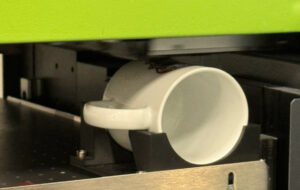
- Handled mugs and drinkware - the handle’s height difference is no longer a barrier
- Stepped and tiered tumblers - print across ridges, grooves, and surface variations
- Stress balls and rounded objects - achieve up to 25% wrap on curved surfaces
- Sports equipment - pickleball rackets, paddles, and items with mixed surface heights
- Hard hats and industrial items - print across brims and domed surfaces
- Promotional products - any item with contour, texture, or irregular geometry
If you’ve ever had to turn down a job because the surface wasn’t flat enough, High Throw Technology is built for exactly that scenario.
Who Needs High Throw / High Gap Printing?
The demand for this capability cuts across industries. Inkcups sees the strongest demand from:
- Promotional product decorators printing on branded merchandise with complex shapes
- Industrial manufacturers decorating hard hats, tool handles, and equipment
- Sports and leisure companies personalizing equipment and gear
- Drinkware decorators expanding into handled mugs and specialty vessels
- Injection molding operations printing directly on molded parts with surface variation
- Electronics manufacturers decorating components with uneven geometry
If your business is turning away jobs because a surface isn’t flat enough, or if you’re manually masking and repositioning items to work around height variations, the X5-T High Throw eliminates that friction.
Is High Throw / High Gap Printing Right for Your Operation?
The clearest signal that this technology belongs in your shop is if any of the following sound familiar:
- You’ve turned down jobs because the substrate had a handle, ridge, or irregular surface
- You’re pad printing items you’d prefer to decorate digitally – for full color, photo quality, or shorter run flexibility
- Your customers are asking for decoration on handled drinkware and you’re sending them elsewhere
- You’re producing sports equipment, promotional products, or industrial items where surface geometry varies
- You’re losing margin on workarounds – repositioning items, masking surfaces, or running multiple passes
High throw / high gap printing eliminates these friction points. The job that was previously a problem becomes a standard production run.
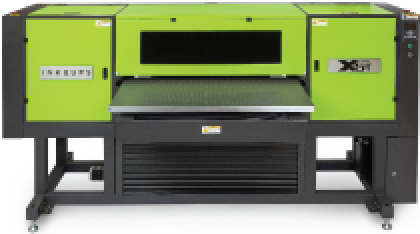
The X5-T High Throw is built on Inkcups’ proven X5-T UV flatbed platform, enhanced with purpose-engineered high throw capabilities:
- Max part height: 19.7″ (500mm) – print on exceptionally tall items
- Print bed: 43″ x 24″ (1100 x 610mm) – batch multiple items or handle large industrial parts
- Ink configuration: CMYKWW or CMYKW + Varnish
- Curved surface coverage: Up to 25% wrap on rounded substrates
- Ink type: UV LED-curable – no special formulation required for high throw applications
 Tagless Printers
 Cylindrical Inkjet Printers
 UV Flatbed Printers
 Pad Printing Machines
 Pretreatment Systems
 Inkjet Printing Auxiliary
 Laser Plate-Makers
 Inkjet Printing Supplies
 Pad Printing Supplies
 Tagless Supplies
Add Your Comment