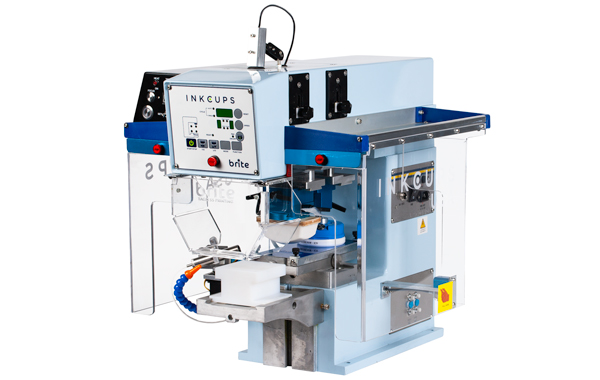
 Tagless Printers
 Cylindrical Inkjet Printers
 UV Flatbed Printers
 Pad Printing Machines
 Pretreatment Systems
 Inkjet Printing Auxiliary
 Laser Plate-Makers
 Inkjet Printing Supplies
 Pad Printing Supplies
 Tagless Supplies
You’re holding a pen right now. Or maybe a golf ball, a phone case, a TV remote. Look closely at the logo printed on it. That crisp little image didn’t get there by magic, but the process that put it there is pretty close.
It’s called pad printing, and it’s one of the most ingenious, underappreciated technologies in modern manufacturing.
From Swiss Watchmakers to Your Keychain
Pad printing has a surprisingly elegant origin story. It was born in the Swiss watch industry, where craftsmen needed a way to decorate intricate watch faces with razor-sharp precision. The challenge? Watch faces aren’t flat, and neither are most of the objects we use every day.
That’s the genius of pad printing. By using a soft, flexible silicone pad as an intermediary, ink can be picked up from a flat engraved plate and then conformed onto curved, uneven, or irregular surfaces. It’s why the logo on your mouse looks just as clean as the one on your lighter or your golf tee.
Today, pad printing touches virtually every product category imaginable: gifts and premiums, sporting goods, electronics, cameras, mobile phones, keyboards, and even textile garments. If there’s a logo on it, there’s a good chance pad printing put it there.
The Alchemy of Ink: A Process That Defies the Laws of Thin
Here’s where things get truly mind-bending.
Pad printing works at a scale almost too small to imagine. The image is engraved (or “etched”) into a steel plate to a depth of just 25 microns (that’s 0.025 of a millimeter). For context, a human hair is roughly 70 microns wide. The etching is shallower than that.
From that impossibly thin reservoir of ink, only half is picked up by the pad on each cycle. And of that wet ink film, a full 60% is solvent that evaporates into the air before the ink even reaches your product. What’s left? A dried ink deposit of just 5 microns.
Five microns. The logo on your pen is a film so thin it’s essentially invisible in cross-section, yet it’s sharp, durable, and exactly right.
Why Timing Is Everything
That evaporation isn’t a flaw in the process; it’s the point of it. But controlling it is an art form.
The ink must be tacky at exactly the right moment. Too fast, and the ink dries in the plate before the pad can even pick it up. Too slow, and the ink won’t release cleanly from the pad onto your product. Either extreme produces the same frustrating result: no image.
Temperature, humidity, airflow, static electricity: all of it matters. Pad printing operators are essentially conductors of a very fast, very precise chemical performance happening at the microscopic level, dozens or hundreds of times per minute.
The Plate: Where Quality Begins (and Ends)
Every pad-printed image is only as good as the plate it came from.
The etch must be consistent across the entire image area, with no variation in depth and no irregularities on the floor of the engraving. For large image areas, the etch depth may be pushed to 30 microns, but rarely beyond that. Push too far and the delicate ink balance falls apart.
And the steel itself matters. Inferior-quality steel with a poor crystalline structure will produce flaws in the etch, and those flaws show up as imperfections in every single print. It’s a reminder that even the most advanced printing process is only as good as the foundation it’s built on.
The Next Time You Pick Up a Pen…
…take a second to appreciate the invisible science on its surface. That logo traveled through a Swiss-inspired process, balanced on the edge of evaporation, transferred by a flexible silicone pad, and landed in a film thinner than a bacterium, all in a fraction of a second.
Pad printing isn’t just manufacturing. It’s physics, chemistry, and craftsmanship happening at a scale the naked eye can’t see. And it’s quietly everywhere.
To learn more about pad printing equipment, please visit: https://www.inkcups.com/pad-printing-machines/
Add Your Comment